Risk-Free Rate
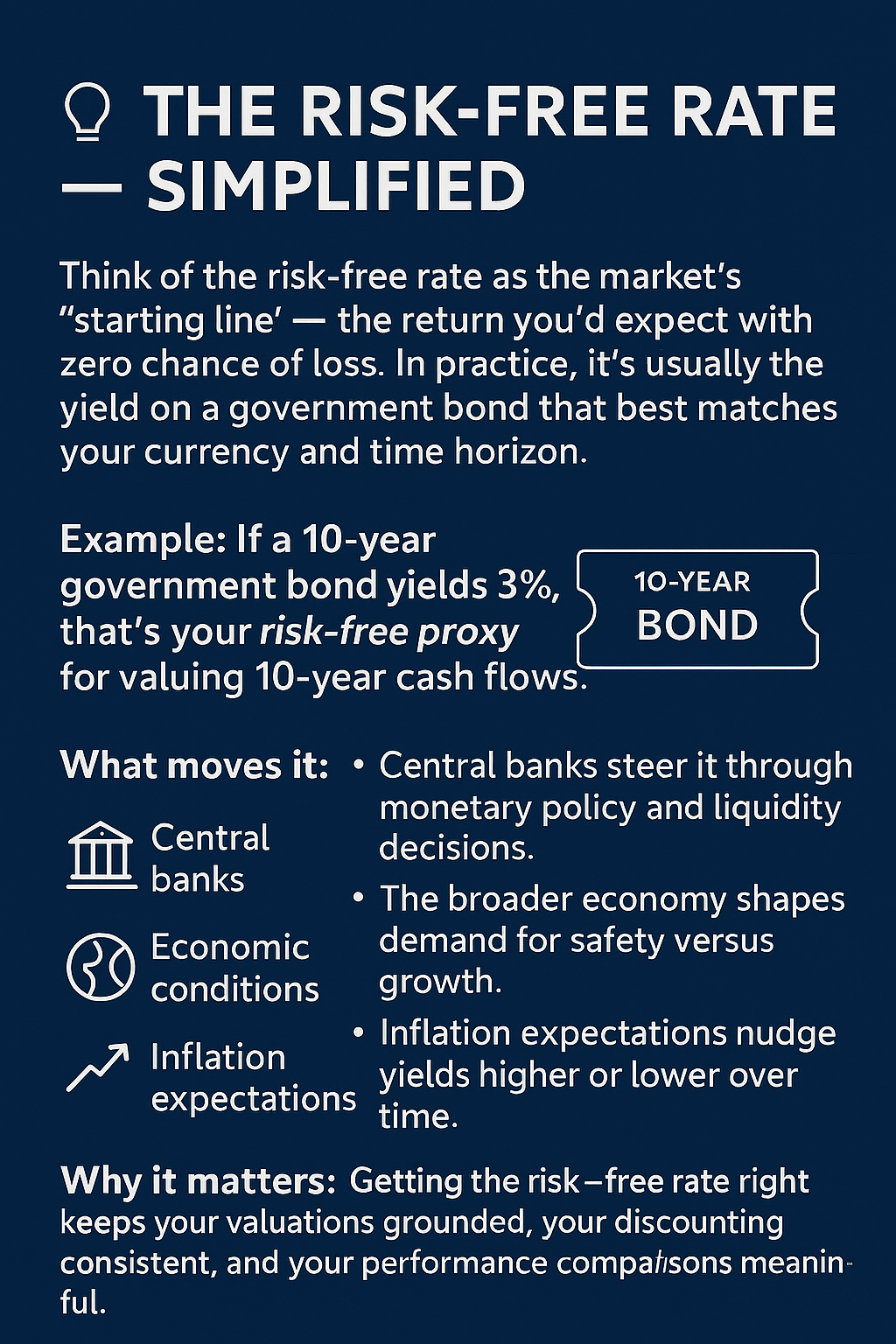
The risk-free rate is the baseline return with zero expected loss — typically proxied by a government bond yield that matches your cash-flow’s currency and duration.
Example:
If a 10-year government bond yields 3% annually, that becomes your risk-free proxy for valuing 10-year cash flows.
What drives it:
▪️ Monetary policy sets interest rate direction and liquidity.
▪️ Economic health shapes demand for safe assets vs risk assets.
▪️ Inflation expectations push nominal yields higher or lower over time.
Why it matters:
A well-calibrated risk-free rate keeps your valuations anchored, discounting consistent, and benchmarks fair across markets.
Real-Time Case Study: Indian 10-Year G-Sec
▪️As of October 2025, India’s 10-year government bond yield is around ~6.50 % (INR-denominated). Trading Economics
▪️If you’re valuing a 10-year rupee cash-flow, that ~6.50 % becomes your default risk-free proxy, not a U.S. Treasury yield.
▪️But note: that yield already embeds term premium, inflation expectations, and some liquidity risk — it’s a practical approximation, not a pure zero-risk rate.
▪️In cross-currency valuation (e.g. rupee vs USD exposures), you’d adjust via currency swap spreads or use synthetic USD risk-free curves to avoid misalignment.
▪️Also, for collateralized derivatives in Indian/Asia markets, the OIS or collateral curve may diverge from the nominal G-Sec curve, and should be used for accurate discounting.